viernes, 31 de julio de 2015

¡Otra hermosa reseña!

Segunda reseña, preciosa. Muchísimas gracias.

BLOG: Every fairytale needs a good old-fashioned reader


BOOK REVIEWS: MEMORY BY TERESA P. MIRA ECHEVERRÍAI received a free e-version copy of this story
from the publisher in exchange for an honest review. Thank you so much!This novelette, written by an Argentine author,
is the story of Jedediah, a Mars colonizer, who tells his story from his
younger years to his adulthood. Jedediah’s life was always marked by the
silence of his father, the dustiness of Mars, his solitude, and his neighbor’s
pink car. One day, he meets Ajax, a native, one of the people who were
genetically created and modified to the terraforming of Mars. The natives’
lives should be entirely devoted to making Mars a suitable place for humans.
Later, they would be used as slaves. Ajax was one of the leaders of the
revolution intent on freeing Mars from human captivity. Even though they only
met once when Jedediah was young, a connection was formed. Jedediah grew,
started working, and then set off to find Ajax. Meeting him, he found more than
he was expecting: he found love, a sense of belonging, a home.  The
novelette is divided into several short pieces, each one telling a little bit
of Jedediah’s growth and how he views the planet he lives on. We get to see his
childhood, his adulthood, and his own children and how Mars modifies them and
connects them. It was a lovely narrative about human behavior,
emotions and actions: colonization, coming of age, love, sexuality, family,
right and wrong, memory, and many other themes were discussed in this short
narrative. The singularity of Mars gave space to a singular narrative, in which
different characters, perspectives, and situations were intertwined to form a
unique, and sometimes thought-provoking, story. The importance of memory and
its role, how it modifies the way we behaved was explored in a different way,
in which the consequences of one’s actions could transform the future radically
and alter not only the person’s reality, but the reality of a whole world. I would recommend this novelette if you are
interested in a quick, deep read and, of course, if you like science fiction
stories!
BOOK REVIEWS: MEMORY BY TERESA P. MIRA ECHEVERRÍA
I received a free e-version copy of this story from the publisher in exchange for an honest review. Thank you so much!
This novelette, written by an Argentine author, is the story of Jedediah, a Mars colonizer, who tells his story from his younger years to his adulthood.
Jedediah’s life was always marked by the silence of his father, the dustiness of Mars, his solitude, and his neighbor’s pink car. One day, he meets Ajax, a native, one of the people who were genetically created and modified to the terraforming of Mars. The natives’ lives should be entirely devoted to making Mars a suitable place for humans. Later, they would be used as slaves. Ajax was one of the leaders of the revolution intent on freeing Mars from human captivity. Even though they only met once when Jedediah was young, a connection was formed. Jedediah grew, started working, and then set off to find Ajax. Meeting him, he found more than he was expecting: he found love, a sense of belonging, a home.
The novelette is divided into several short pieces, each one telling a little bit of Jedediah’s growth and how he views the planet he lives on. We get to see his childhood, his adulthood, and his own children and how Mars modifies them and connects them.
It was a lovely narrative about human behavior, emotions and actions: colonization, coming of age, love, sexuality, family, right and wrong, memory, and many other themes were discussed in this short narrative. The singularity of Mars gave space to a singular narrative, in which different characters, perspectives, and situations were intertwined to form a unique, and sometimes thought-provoking, story. The importance of memory and its role, how it modifies the way we behaved was explored in a different way, in which the consequences of one’s actions could transform the future radically and alter not only the person’s reality, but the reality of a whole world.
I would recommend this novelette if you are interested in a quick, deep read and, of course, if you like science fiction stories!

lunes, 27 de julio de 2015

Primer reseña de "Memory" en inglés y es... WOW

¡Realmente, no podría estar más feliz!

MEMORY by Teresa P. Mira de Echeverría is a Mind Expanding Sci-Fi Read

REVIEW SUMMARY: Memory is a lyrical meditation on the nature of love when it is freed from Earth-bound traditions.
MY RATING:  
BRIEF SYNOPSIS: When a human and Martian “native” fall in love, their union and their work reversing the terraformation of Mars forces them to consider the nature of memory and their own expectations for the future.
MY REVIEW:
PROS: Graceful style;compelling characters.
CONS:  A bit too compressed at certain points in which years are skipped over quickly.
BOTTOM LINE: Read Memory if you like expanding your mind and reading a good story at the same time.
There are so many reasons why I love this novelette, but the main one is that Argentine author Teresa P. Mira de Echeverría subverts expectations so gracefully and expertly (and this comes through clearly in Lawrence Schimel’s translation from the Spanish). Originally published in Terra Nova: An Anthology of Contemporary Spanish Science Fiction,Memory functions well as a free-standing novelette, raising numerous tantalizing questions and ideas in the reader’s brain without offering much closure.
And while Memory is labeled “science fiction” because of its Martian setting, genetically-engineered characters, and discussions of terraforming (and its reverse!), it is ultimately a book about love that transcends genre. Here we have the story of a human boy (Jedediah) who is drawn to a Martian “native” (Ajax)- one of the genetically-engineered humans sent to Mars hundreds of years before to terraform the planet. These natives are ostracized by the humans living on Mars, and they live in their own peripheral communities.
Jedediah grows up determined to leave his neglectful father and join Ajax to work with him on returning Mars to its pre-terraformed state. Ultimately, Jedediah and Ajax acknowledge their mutual love and commit themselves to one another for life. Mars, though, is not Earth, and its inhabitants are not bound by traditional human beliefs about marriage and binary relationships. Rather, this new civilization forged by native-human relationships is all about multiplicity and generosity. Many of the family units contain three, four, and even five members who have committed themselves to one another. The children that they have are raised by the entire unit.
What makes this story especially compelling is Ajax’s ability to see his memories of the future: as he explains to Jedediah, “One part of my memory works forwards…Glimmerings of you have always accompanied me.” Memory, for Ajax, then, is not simply a calling-up of the past, but also a way to choose a specific future, one that includes a beloved partner. In this way, memory is an active thing: the natives can choose certain paths based on a preferred future, just as they can reverse the terraforming process that they themselves initiated hundreds of years before. A memory of Mars as it once was informs their drive to take it back from Earth, even though the natives themselves came from Earth, too.
In many ways, Memory reminds me of Bradbury’s The Martian Chronicles in terms of the latter’s use of Mars as a kind of exotic backdrop to the human drama that plays itself out. De Echeverria, like Bradbury, is interested less in the science of Mars and more in what it means for humans to colonize and change another planet- what does this do to humans’ perceptions, beliefs, and desires? How does a radically different environment change how we think about what it means to be human?
Most interesting of all, to me, is how much Memory makes me think about a famous novella (Death in Venice) by my favorite author of all time (the German writer Thomas Mann). Mann’s story, too, explores desire and “unconventional” love and its connections to art, memory, and death. Unlike Memory, though, Death in Venice despairs for a world in which love isn’t policed and bounded. De Echeverria’s story, in its lyrical and ultimately positive portrayal of non-binary, expansive love, seems like the answer to Death in Venice‘s question.
Memory would work wonderfully expanded into a full-length novel, since it seems so compressed in its current form (jumping ahead over years, etc.). Nonetheless, de Echeverría offers us a unique vision of human evolution- both biological and social- and she does this with lyricism and grace.

martes, 30 de junio de 2015

Cuenta regresiva al 27 de Julio

...PORQUE EL 27 DE JULIO sale a la venta en EEUU y en el mundo 
(vía Amazon) mi novela corta/cuento largo (novelette): 
 "MEMORY"!

Ya están en pre-venta aquí.
¡Estoy tan feliz!

Gracias a tanta gente que me apoyó, a todos los amigos de taller "Los clanes de la Luna Dickeana" (Guille, Rolcon, Rox, Jorge, Facu, Fede, Lex, Paula, Omar, Vero, Adrián, Dany, Lau y Gabriel).

A quienes publicaron ese cuento por primera vez en Terra Nova: Mariano y Luis y, claro, también Rodolfo.

Y al maravilloso Lawrence que hizo taaaaaaanto, tantíiiiiiiiiiisimo por esta novelette. Y a Joanne de UPPER RUBBER BOOT BOOKS

Y a la primera gente que creyó en la historia una vez publicada y la apoyó con todo: Cristina y Elías.

Y a mis amigos incondicionales... Sí: Bernardo, Inés S., Miguel Ángel, Eva, Inés G., Sandra, Juana, Diana... y muchos más.

Y a Guillermo, el amor de mi vida.

Y a mi mamá, Olga, que me empuja contra viento y marea para adelante.

Y, sobre todo a mi papá, Héctor, a quien va dedicada... Sin él y su empuje, desde aquel "2010, Odisea dos" hasta llevarme de la mano a las estrellas, nada de esto hubiera sido posible.


miércoles, 17 de junio de 2015

Anunciada en EEUU mi novela corta MEMORY


Felicidad absoluta, en una entrevista, mi editora en EEUU, Joanne Merriam tiene la amabilidad de nombrar mi próxima publicación.
Muchas gracias Joanne y muchas gracias Lawrence Schimel, maravilloso traductor y gestor de sueños!!!!!!!!

(TODA la entrevista vale la pena, pero en el punto 5 radica mi alegrón, jaja)


Science Book a Day Interviews Joanne Merriam


joanne-merriam
Special thanks to editor Joanne Merriam for answering 5 questions about her recently featured book – How to Live on Other Planets: A Handbook for Aspiring Aliens
Joanne Merriam is the owner and editor of Upper Rubber Boot Books, and former editor of Seven by Twenty. Joanne Merriam’s poetry and fiction has appeared in dozens of magazines and journals, including The Antigonish Review, Asimov’s Science Fiction, The Fiddlehead, The Furnace Review, Grain, The Magazine of Speculative Poetry, The Mainichi Daily News, Per Contra, Riddle Fence, Room of One’s Own, Strange Horizons and Vallum Contemporary Poetry, as well as in the anthologies Ice: new writing on hockey, To Find Us: Words and Images of Halifax and The Allotment: New Lyric Poets. – Adapted from Joanne’s Homepage
Joanne’s Homepage: http://www.joannemerriam.com
#1 – What was the impetus behind How to Live on Other Planets?
I’m an immigrant (from Canada to the US) and often have to fill out forms in which I’m referred to as an alien by the government, so it seemed like a natural topic for a science fiction anthology! I did some research and couldn’t find any pre-existing collections, so I decided to just go for it.
#2 – How many authors are part of this book? How did you collect and choose which stories to include?
There are 36 writers in the book, from 12 countries. I posted an open call for submissions on the Upper Rubber Boot Books website, and then promoted the link on Twitter, Tumblr and Facebook. I had about 200 submissions if I recall correctly, many with multiple stories, so I probably read more like 300-400 stories and poems to select the ones in the book.
My selection criteria were that it had to have already appeared in a magazine (because I couldn’t afford to pay pro rates for new work but could pay competitively for reprint rights), and it had to make me say, “Wow!” at some point in the story. I also tried not to have much overlap between stories, and I wanted stories that drew from cultures around the world, so some really good stories ended up getting rejected because they were too similar to other work I’d already accepted.
#3 – Your book doesn’t only deal with aliens, but all manner of ‘otherness’ in various scenarios. Which was your favourite story?
It’s hard to choose just one, but I’d say probably Benjamin Rosenbaum’s “The Guy Who Worked For Money” is my favourite. The idea that an apparently post-scarcity economy (that instead runs on popularity and social connections) could really screw over somebody for having unpopular opinions, really resonated with me.
#4 – What feedback have you received about the book?
It’s already our second most popular title (of 12) and it’s not even been out two months yet, so I feel like it’s been pretty well received! Most of the critics have been kind, and a lot of people have commented on how thought-provoking the stories are.
#5 – Are you working on any new books/projects you can tell us about?
Sure – our next two titles are single-author books: a novelette by Argentinian writer Teresa P. Mira de Echeverría called Memory about a revolution on a terraformed Mars, and a rock and roll novella called Flight 505 by American writer Leslie Bohem (formerly a rock and roll musician himself, but better known as the writer of the Emmy-award-winning mini-series Taken).
We also have The Museum of All Things Awesome and That Go Boom, an adventure science fiction anthology which is slated for spring 2016 release. I’m still waiting on contracts, but can tell you that contributors include Ken Liu, K. Ceres Wright, Kelly Luce, Kristin Bock, Leonard Richardson, Sequoia Nagamatsu, Ursula Pflug, Nick Kocz and Nick Wood.
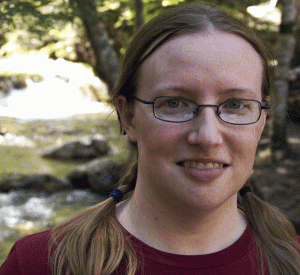
[Image Credit: Peter Merriam, http://www.upperrubberboot.com/wp-content/uploads/2011/10/Author_photo-300×275.gif ]


lunes, 8 de junio de 2015

AMOR, un cuento mío en "Ficción Científica"

 ¡Hoy tengo una enorme alegría!

"Prudence II" de Michael Whelan
 Acaban de publicar un cuento mío en una excelente publicación FICCIÓN CIENTÍFICA (red social de literatura de ciencia ficción y fantasía).

 Podría decirse que es un cuento "poco habitual" (por ser de fantasía y encima incluir brujas y vampiros en él), pero sigue en la temática general de mi escritura: las relaciones, las formas de vinculación, el simbolismo que puede intervenir en su expresión, y un largo etc.

 Se trata de mi cuento corto "Amor" [haciendo click sobre el nombre cuento pueden ir a leerlo a la página], por el que tengo un cariño especial, máxime luego de que me hiciera el favor de leérmelo la gran escritora Pilar Pedraza y lo elogiara llamándolo "intensísimo y poético".
"Awakening" de Tom Wood

 Y lo que no puedo ni quiero es dejar de agradecer la enorme generosidad de José Antonio Cordobés Montes al escogerlo para ser publicado. ¡Muchísimas gracias! 

(encima con una recomendación como ésta: 
"Esta semana en
Ficción Científica un relato de Teresa P. Mira Echeverria, "Amor", os recomiendo leerlo, espectacular").

 Como siempre, espero que les guste.

 Las ilustraciones y la música que acompañan esta entrada son, justamente, aquellas con las que me inspiré para escribir el cuento (así que va con banda de sonido y todo).


miércoles, 20 de mayo de 2015

CUENTO POR ENTREGAS… Parte 9 de 9


Llegamos al término de este "cuento por entregas": la esperada NOVENA PARTE de nueve.
Un final que, como verán, es "engañoso"... o, tal vez, "mítico"... que es lo opuesto al engaño, ya que el Mito es la más verdadera de las verdades.
¿Y cómo aparcería hoy Ikur?... Tal vez sería una especie de fauno espacial. Un ser esencialmente híbrido, alguien con un poco de animal y otro de humano, como mucho de masculino y mucho de femenino, con blancos perfectos y complejos negros. 
Pero el Ikur que leeremos hoy pertenece a "aquel cuento". Un cuento nacido bajo la influencia de High Hopes de Pink Floyd y El hombre y sus símbolos de Carl C. Jung
Les dejo pues a este, mi "hijo", ya adulto y libre para vagar por sus propios caminos, tal como todo cuento concluido. Un hijo que, en definitiva, es mío pero también suyo, querido lector. Después de todo, usted lo revestirá de un rostro particular, le dará una voz propia y le adjudicará un modo de andar, de torcer el gesto o de sentarse que será único e irrepetible.
Así que, cuando vea en Ikur un dejo de mis rasgos, fíjese bien, y descubrirá también en él, un poco de los suyos...

 .  · .  · .  · .  · .  · .  · .  · .  · .  · .  · .  · .  · .  · .  · .  · .  · .  · .  · .  · .  · .  · .  · .  · .  · .  · .  · .  · .  · .  · .  · .  · .  · .  · .  · 


EL ÁNIMA Y EL HOMBRE DE LA RUEDA GIGANTE


(por: Teresa P. Mira de Echeverría)


[Estar encadenado, bajo cualquier tipo de cadenas, es algo literalmente terrible.
Estar encadenado por uno mismo, por propia responsabilidad, bajo propia mano —o como se quiera decir— es casi insoportable.
Y nótese que digo casi, porque esto es lo más común del mundo; me atrevería a decir que es inherente a la raza humana.]

9: El vuelo.

Las alas-raíces volaron primero por sí mismas. Y luego, una vez estabilizado su vuelo, obedecieron las órdenes de Ikur.
"Ritos de pasaje" - John Jude Palencar
Sus raíces-alas lo llevaron sobre zonas volcánicas en formación: una tierra nueva recién nacida.
Ikur volaba tal como vuelan las semillas de un diente de león, en parte guiado por el viento y en parte por su deseo inconsciente.
La tierra se abría en bocas volcánicas y nuevos terrenos apenas formados se desvanecían en nuevas erupciones de lava renovadora.
Volcanes, lava, novedad... la tierra se adivinaba como un lugar en formación.
Ikur buscaba un sitio que le gustase, un sitio ya establecido y formado.
Se adentró más y más en la tierra de la incógnita y atravesó herbazales y desiertos, mares y costas, montañas y sierras, pero no encontraba su lugar.
Finalmente, Ikur llegó a una planicie verde con tres grandes álamos en su mitad, sus únicos pobladores en una inmensidad esmeralda.
Allí bajó, plegó sus alas y se sentó a trabajar bajo los álamos.
Pasaron los años y los años, e Ikur continuaba trabajando bajo sus tres queridos álamos.
La lluvia y el sol lo bañaron, y disfrutó intensamente de sus mensajes.
Los pájaros volaron sobre su cabeza, y él admiró sus trinos y la alegría que contagiaban.
El milagro de los amaneceres rojos y malvas transcurrieron frente a sus extasiados ojos.
"El fantasma en las colinas" - John Jude Palencar
Vinieron a pedirle ayuda y sus manos siempre estuvieron dispuestas.
Vinieron a ofrecerle ayuda, y sus oídos oyeron y sus labios agradecieron.
Y pasó mucha vida, e Ikur la bebió hasta el último sorbo, saboreando cada gota.
Y un día Ikur sintió que sus alas se desperezaban de nuevo y que los álamos le cantaban en el susurro de sus hojas con más fuerza que nunca.
Ikur sonrió al horizonte que se desplegaba frente a sí, y comprendió que debía cumplir el artículo tercero de la Ley del Tiempo... Cambiarás.


 Ser libre de ataduras, de cualquier atadura, es algo literalmente maravilloso.
Estar libre, liberado por sí mismo, por propio esfuerzo, gracias a una heroica lucha ¾o como se quiera decir¾ es casi milagroso.
Y nótese que digo casi, porque esto es lo más común del mundo; me atrevería a decir que es inherente a la raza humana.


(SIN) FIN


domingo, 17 de mayo de 2015

Una novela corta mía sale en inglés!!!!


Felicidad absolutaUna novela corta (novelette) mía, "Memoria" va a salir en el invierno austral (si Dios quiere) en una editorial de EEUU (Upper Rubber Boot Booksy estoy MUY feliz.


Gracias a Lawrence Schimel y a Joanne Merriam (de Upper Rubber Boots Books) por confiar en mí.
Y, por supuesto, a Mariano Villarreal y Luis Pestarini que eligieron en mi primera instancia mi cuento "Memoria" para Terra Nova 1 (y a Rodolfo Martinez de la Editorial Sportula, que creyó en el proyecto).

Cuando fui elegida para estar lado a lado junto a gigantes como Lola Robles, Víctor Conde, Ken Liu o Ted Chiang, y A MI ADMIRADÍSIMO Ian Watson (y otros grandes escritores), no lo podía creer... Ahora menos!!!!!!!

Tengo que agradecer especialmente a Cristina Jurado, que apoyó ese cuento desde que salió publicado y a Elías Combarro (Odo) por su apoyo constante.


Y, claro, a mi amado Guillermo Echeverría (la otra mitad de Rockwell-Hopper y de mi vida) y a mis amigos del Taller Literario "Los clanes de la Luna Dickeana" (y mis brillantes compañeros de la Antología Steanpunk) que me ayudaron y animaron a escribir y mandar ese cuento [Laura Ponce, Verónica Vázquez, Paula Andrade, Roxana Lozano, Federico Caivano, Facundo Córdoba, Jorge Korzan, Dany Vazquez (Axxonita), Rolando Condis (Rolcon), Omar Munarriz, Marcelo Cardo (Lex), Andrián Paredes y, en aquella época, Adriana Cantero].

FELICÍSIMA


miércoles, 13 de mayo de 2015

CUENTO POR ENTREGAS… Parte 8 de 9


Ikur llega hoy a la OCTAVA PARTE de nueve, de este "cuento por entregas".
Cerca del final de su recorrido, las transformaciones deberán ser drásticas a riesgo de truncar su viaje heroico. Pero los símbolos se volverán un poco más elocuentes, también. 
¿Cómo narraría hoy la historia de Ikur?... Posiblemente su Sombra no sería tan pacífica, sino una entidad más brutal, descarnada, titánica; tal vez un enorme y monstruoso ser leviatánico que nadara entre estrellas, y con el cual luchar, medir fuerzas y, finalmente, hacer las paces. 
El Ánima también sabría nadar entre soles, pero tendría un aspecto y personalidad un tanto más ambiguas... ¿hermafrodita, tal vez? 
Pero las pinturas, definitivamente, seguirían estando allí; y el vuelo final no podría ser más majestuoso. 
Así que volvamos a "aquel cuento", mientras escuchamos High Hopes de Pink Floyd de fondo (y le vamos sacando nuevas resonancias, así como obtenemos nuevas lecturas de El hombre y sus símbolos de Carl C. Jung). 
Adelante, entonces, con el ante último capítulo de esta historia de Ikur.

 .  · .  · .  · .  · .  · .  · .  · .  · .  · .  · .  · .  · .  · .  · .  · .  · .  · .  · .  · .  · .  · .  · .  · .  · .  · .  · .  · .  · .  · .  · .  · .  · .  · .  · 


EL ÁNIMA Y EL HOMBRE DE LA RUEDA GIGANTE


(por: Teresa P. Mira de Echeverría)


[Estar encadenado, bajo cualquier tipo de cadenas, es algo literalmente terrible.
Estar encadenado por uno mismo, por propia responsabilidad, bajo propia mano —o como se quiera decir— es casi insoportable.
Y nótese que digo casi, porque esto es lo más común del mundo; me atrevería a decir que es inherente a la raza humana.]

8: El ánima.

Tal como el paisaje, Ikur —hundido en su desesperación—, fue cubierto por el blanco manto níveo; hasta que, desde el suelo, su sombra se levantó.
"Claro de Luna" - Alphonse Mucha
La negra forma ausente de luz se irguió frente a él.
Ikur siguió a su sombra por varios kilómetros, hasta que cruzó el límite entre la nieve y el sol.
Una vez transpuesto el borde, la sombra desapareció.
La sombra le había hecho cuestionarse a Ikur lo que en verdad era él. Tenía una parte de su ser oscura, una parte que no necesariamente era mala, sino algo que sólo era “otra parte”.
Pero cuando la sombra desapareció, otra figura ocupó su lugar: la vaporosa mujer que lo guiaba había regresado.
Caminó silenciosa, muda, frente a él. Y nuevamente comenzó la peregrinación.
Un nuevo borde apareció adelante. Un nuevo límite. Otra frontera.
La damisela se detuvo frente al precipicio de un gran cañón montañoso. Y, señalando el vacío oscuro y lleno de abigarrados nubarrones que se constituía frente a ellos —mientras era bañada por un viento fuerte que hacía ondular su vestido ocre orlado de perlas—, exclamó sin hablar: “Terra incognita”. Y desapareció.
Ikur caminó a lo largo del acantilado: el vacío a su derecha, una inexpugnable pared rocosa a su izquierda.
Finalmente halló una cueva y se introdujo en ella. Encontró una tea encendida y la tomó. Y, mientras avanzaba, vio pintados sobre las paredes de la cueva, todos los eventos de su vida en tonos rojos y negros. Eran dibujos simples, esquemáticos, pero sublimes; y era como si tuviesen milenios. Como si existieran desde antes que la piedra misma que los soportaba... Como si su forma fuera previa a su materia...
Allí estaba él con las cadenas en medio de un grupo de toros...
Allí, el cangrejo rojo se deslizaba por entre las patas de un mamut...
Más allá, el hombre de la rueda gigante yacía en la nieve, bajo un bosque de jirafas...
La gente de las grandes ilusiones, el monstruo de franjas negras y amarillas, y la sombra se alzaban juntos, más acá, muy cerca de dos hermosos caballos rojos.
Y, en medio del conjunto rupestre, el roble en el mar amarillo dejaba que un tótem asomase por entre su copa.
"Hombre con alas alza el vuelo" - Frank Frazetta
Sin saber por qué, Ikur tomó un trozo de carbón y comenzó a redibujar aquello: hizo que el mar fuera de plata, y que el cangrejo se tornara en una tortuga gigante, y le colocó cabello verde a la mujer vaporosa, y pintó una tumba digna para el hombre de la rueda gigante, con el símbolo de un caracol sobre ella.
Reescribir su memoria era como volver a vivirla. Le daba sentido al pasado. Lo volvía presente.
Ikur comprendió que era hora de avanzar por primera vez en sentido no lineal, fuera del plano de su vida, hacia el eje de la altura de su lo-que-sea-que-lo-llamaba-desde-dentro (digámosle: alma).
Giró sobre sus pies, llegó al borde de la cueva, y enfrentó el precipicio apoyando su espalda contra la pared de sus recuerdos. Entonces dio un paso en el vacío.
Mientras caía, entendió que no debía luchar, ni resistirse; y que así como el árbol desarrollaba sus raíces naturalmente y sin luchar, él debería desarrollar las suyas en paz.
Ikur cerró entonces sus ojos y sintió cómo, desde su espalda, surgían raíces que se entrelazaban en dos grandes grupos. Y entre las raíces creció una membrana esmerilada, blanca como el cotiledón translúcido de una semilla; y las raíces formaron finalmente dos grandes alas.